
Supply chain nearshoring is no longer just a boardroom buzzword. After the 2026 commodity shocks, many US and UK businesses are rethinking how far their products, parts, and raw materials should travel before reaching customers.
The old logic was simple: manufacture where costs are lowest, ship globally, and keep inventory lean.
That worked until it didn’t. Shipping delays, fuel surcharges, raw material spikes, and maritime bottlenecks have made long-distance supply chains harder to trust. For business leaders, the concern is practical: how do you protect margins without raising prices every time global trade logistics gets messy? That is where supply chain nearshoring is becoming a serious enterprise operations strategy.
Why supply chain nearshoring is gaining speed
Supply chain nearshoring means moving production, sourcing, or assembly closer to the end market. For US companies, that may mean shifting some operations to Mexico, Central America, or domestic regional hubs. For UK businesses, it may involve Eastern Europe, North Africa, or closer European supplier networks. This does not always mean abandoning offshore suppliers completely.
It means reducing dependence on one distant source. The problem with traditional offshoring is not only distance. It is exposure. A company may save on production costs, then lose those savings through port delays, emergency air freight, higher insurance, inventory shortages, or missed sales. That is the hidden cost many businesses ignored for too long.
Nearshoring vs offshoring
Nearshoring vs. offshoring comes down to total cost, not just unit cost. Unit cost is the price of producing one item. Total cost includes freight, duties, storage, delays, risk, working capital, and customer impact.
A cheap product that arrives six weeks late is not really cheap. Long transit times also force companies to guess demand much earlier. If demand shifts, the business can end up with excess stock in the wrong place or no stock when customers actually want it.
Supply chain nearshoring shortens that decision window. Faster movement means better control, quicker replenishment, and fewer expensive surprises. The smartest supply chain decisions now measure reliability alongside price. A low-cost supplier with high disruption risk may be more expensive than it looks.
Commodity shocks changed the risk conversation
The 2026 commodity shocks reminded businesses that raw material volatility can move quickly. When input costs rise, companies feel pressure from both sides: suppliers charge more, while customers resist price hikes.
That squeeze hurts margins. Margin simply means the money left after costs are paid. If shipping, materials, and storage all rise together, profit can shrink even when sales stay strong. This is why corporate risk management has become central to supply chain planning. Businesses are no longer asking only, “Where is it cheapest?” They are asking, “Where can we still operate if the next disruption hits?”
That is a healthier question.
Building supply chain resilience
Supply chain resilience 2026 is about flexibility. It means having enough options to keep serving customers when one route, supplier, or region becomes unstable.
Nearshoring helps because it creates shorter, more visible supply lines. Trucking, rail, and short-sea routes can often react faster than long ocean freight lanes. Regional suppliers may also allow smaller, more frequent orders.
That improves cash flow. Cash flow is the movement of money in and out of a business. If inventory sits on the water for 45 days, money is tied up before sales happen. Shorter supply routes can reduce that pressure. Supply chain nearshoring can also support better logistics cost management US/UK businesses need when fuel, port fees, and freight rates keep changing.
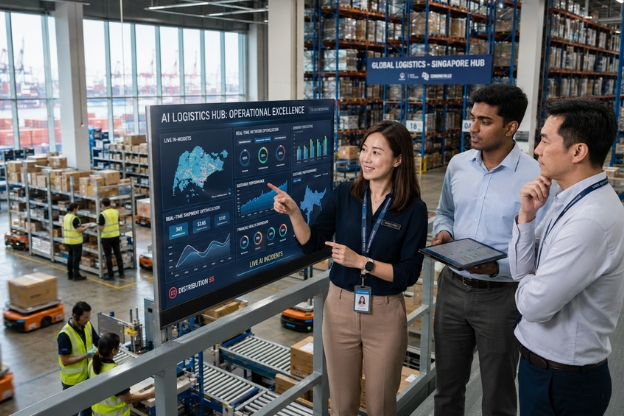
Smart moves for businesses re-routing supply chains
A nearshoring supply chain strategy should be planned carefully. Moving too fast can create new problems.
- Map single-source supplier risks across tier-1 and tier-2 vendors.
- Compare total landed cost, not just factory pricing.
- Build secondary suppliers in nearby trade corridors.
- Keep strategic inventory for critical components.
- Use real-time tracking for shipments, lead times, and supplier performance.
- Review contracts for flexibility during price shocks.
- Avoid passing every cost increase directly to customers.
These steps help with mitigating supply disruptions without creating unnecessary operational chaos.
Why inventory strategy is changing
For years, many companies focused on “just-in-time” inventory. That means keeping stock very low and receiving goods only when needed. It reduces storage costs, but it depends on smooth supply movement.
Disruption changed that thinking. Now more companies are doing “just in case” planning for key items. That doesn’t imply loading the warehouses with everything. That involves storing safety stock of things that would halt production, delay orders or damage customer relationships if they were out of supply.
Supply chain nearshoring suits this strategy, as regional inventory hubs can respond quickly without unnecessary stock being held everywhere. A balanced inventory model safeguards service levels without converting cash into dead stock.
Protect margins without pissing off customers
Sometimes, raising prices isn’t the answer. Customers are already sensitive to inflation, which is just a fancy way of saying that prices go up over time and your buying power goes down. If every logistics shock causes a price increase to the customer, loyalty can be eroded.
Businesses need a better blend: shorter routes, varied suppliers, better demand forecasting, selective inventory buffers, and clearer vendor terms. At first, nearshoring might be expensive, but it can save repeating emergency costs in the long run. That is the bigger financial logic. The return is not only lower freight. It is fewer shutdowns, faster delivery, stronger customer trust, and better control over operating risk.
Conclusion
Nearshoring supply chains is a pragmatic answer to the 2026 commodity shocks since businesses require more than inexpensive sourcing. They require supply chains that bend but don’t break. The optimal approach for US and UK companies is not a total abandonment of international trade. It’s a smarter mix between offshore cost advantages and localized reliability.
Companies may safeguard margins and minimize interruption by mapping supplier risks, developing nearshore alternatives, controlling shipping costs and positioning important inventory closer to demand. Not only will the early adopters withstand the next shock. They’ll respond faster, serve consumers better and turn supply chain risk from a recurring catastrophe into a managed business choice.